Chapter One: The Descent
Again.
The thought comes before the fear, before the cold, before the pressure in my chest.
Why does he do this?
Why is it always me?
The questions surface without effort now. They have become familiar companions, rising whenever I am pushed beyond what I know. My father has always had this way of sending me ahead—into situations I have never encountered, without warning, without instruction. No preparation. No reassurance. Only an unspoken expectation that I will find my way.
I used to resent that silence.
Now I understand it differently.
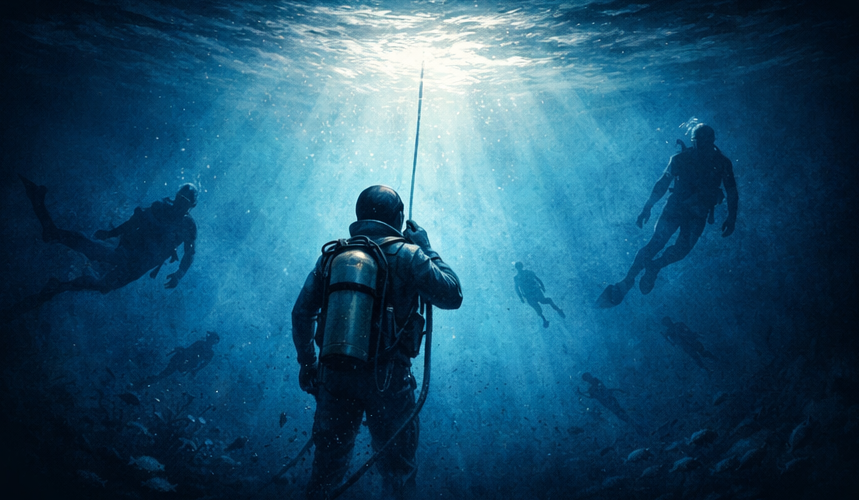
This time, when awareness returns to me, I am already submerged.
The sea stretches endlessly in every direction, a deep blue that feels heavier than darkness. I try to orient myself, but there is no reference point, no sense of scale. I search instinctively for instructions, for signals—anything that might explain why I am here.
There are none. All I can see is a rope tied firmly to my jacket, disappearing upward toward a faint suggestion of light. It does not move. It offers no information. I know only this: when he decides it is time, he will pull me back. Until then, I remain.
Alone. The realization tightens something inside me. Why am I here at all?
The oxygen cylinder on my back is solid, reassuring, finite. I know its limits. A few hours, perhaps less. When it empties, so will my chance of continuing. The thought sharpens my awareness, and I look around more carefully. I am not alone.
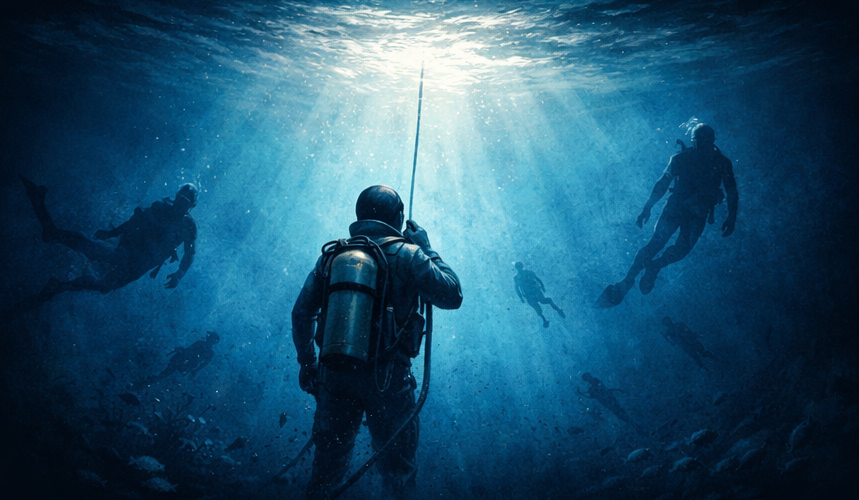
Others drift through the water at varying distances—some near, some barely visible. Their presence should comfort me, but instead it unsettles me. Something is wrong.
They are not using oxygen. I watch them closely, waiting for panic, for signs of distress. None come. Their movements are calm, practiced. They breathe without effort, without equipment. Slowly, unwillingly, understanding begins to form.
They have adapted.
The idea feels absurd at first. Breathing is life. Air is non-negotiable. Every instinct in me rejects the possibility that water could replace it. And yet, the evidence surrounds me.
Time passes. Fear erodes resistance. Curiosity replaces disbelief.
I try. At first, my body revolts. Every attempt feels like a mistake my instincts cannot forgive. But desperation is a persuasive teacher. Gradually, painfully, something changes. I learn to draw water in through my nose, release it through my mouth. Others do it differently, with ease I envy.
What was once sacred—my breath, my most private act of survival—is now shared, recycled, passed through bodies and spaces I cannot see. The discomfort lingers, but it weakens.
When you don’t know how long you must endure, disgust loses its authority.
Adaptation becomes inevitable. And then, without ceremony, breathing becomes effortless. I do not celebrate. I simply continue.
Hunger arrives next, quiet but insistent. The body is relentless in its demands. I watch again, and again I learn. The others eat what the environment provides—small fish, unfamiliar fruits, nourishment without ceremony. I follow.
The questions return, heavier now. Is this how existence is arranged? No guidance. No clarity. Only enough provision to prevent collapse. I do not know why I was sent here. I do not know when this will end. I am one among many, indistinguishable, temporary.
Yet beneath all this, something stirs. Breathing is solved. Eating is solved. Survival continues.
If that is taken care of… then what remains?
The thought lingers until I notice something I had missed before.
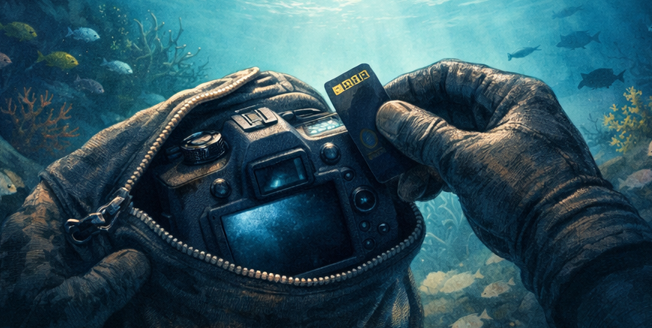
A pouch. Small. Unassuming. Attached to my helmet as if it had always been there. I reach for it slowly, uncertain why my pulse has begun to quicken. Inside, wrapped carefully, deliberately, is an object that feels strangely familiar even before I see it.
A camera. And a memory disk.
The moment stretches. The sea does not change, but I do. The weight of survival recedes, replaced by something quieter, steadier.
This is why I am here. Not to last. Not to be comfortable. To see. To capture my experience.
Now free from panic, I move differently. I swim without urgency, without aimlessness. I observe the contours of the deep, the life that thrives unnoticed, the patterns hidden in silence. I record what I find, carefully, patiently.
Around me, the others continue as before—improving their stay, competing, distracting themselves. Each of them carries the same pouch. They simply haven’t opened it yet. Some haven’t even noticed it yet!
They will. Or they won’t. That is not mine to decide.
I continue my work, collecting what can only be gathered from here, from this depth, from this perspective. Only now do I understand why my father sent me.
He was never interested in how well I survived. He wanted to see what I would capture.
Chapter Two: The Meaning
This story is not about the sea.
It is about our arrival on Earth.
We grow up believing air, water, and food are the most important things in life. And yet, they are everywhere — shared, abundant, external. Survival resources, not the purpose itself. I only need to manage them to remain present.
Then there is something else. The brain!
Placed in the safest position within the body. Protected by bone. Suspended in fluid. Guarded with extraordinary care. Every being is issued exactly one — exclusive, irreplaceable, non‑transferable.
This is not coincidence.
This is intent.
The brain is the camera. Consciousness is the lens. Experience is the data.
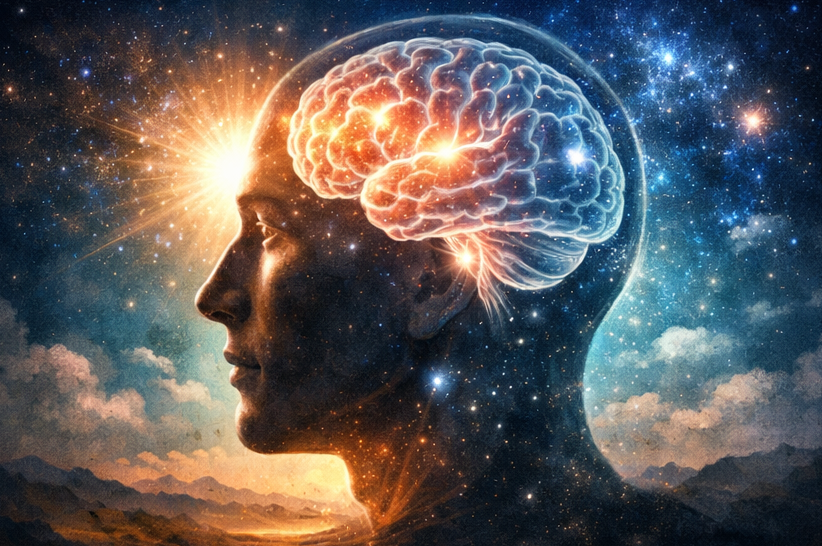
I am not here merely to breathe and consume. Survival is only the entry requirement. I am here to experience reality as it appears to me — to observe, to feel, to understand, and to store that knowing.
That is the assignment. Not imposed by religion. Not dictated by doctrine. Not borrowed from belief. Discovered through direct experience.
What really matters is not how long I last, or how comfortably I stay. What really matters is the knowledge I acquire from the experience I have been provided when the rope is finally pulled.